![Logo_No Tag.png]](https://help.resintech.com/hs-fs/hubfs/Logo_No%20Tag.png?height=40&name=Logo_No%20Tag.png)
By Peter Meyers
Introduction
The hybrids

Simulated fuel pool
A series of bench scale tests was performed to demonstrate the efficacy, determine the amount of hybrid material needed and to verify that boron was not removed and iron did not leach.
The first test was a simulated fuel pool with 2000 ppm boric acid (as B) plus approx. 110 mg/L of silica (as SiO2)
Initial scaling was as follows

The resin columns were configured such that the pump pulled suction from the bottom of the tank and the effluent was returned to the top of the tank. Each morning the contents in the tank was briefly stirred, then sampled. Each afternoon the column effluent was sampled. Samples were analyzed for pH, boron content, silicon, and iron (iron was spot checked).
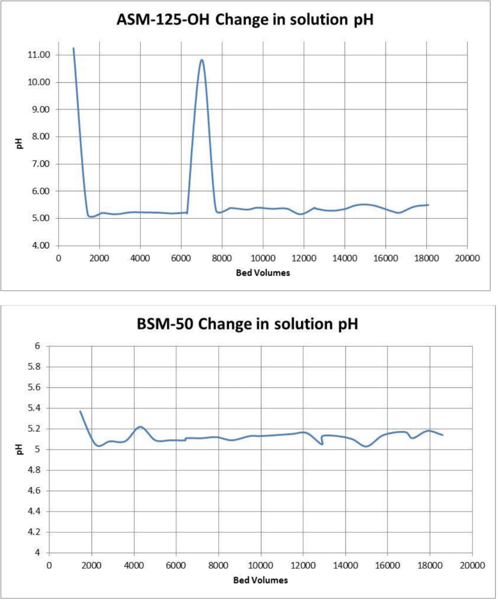
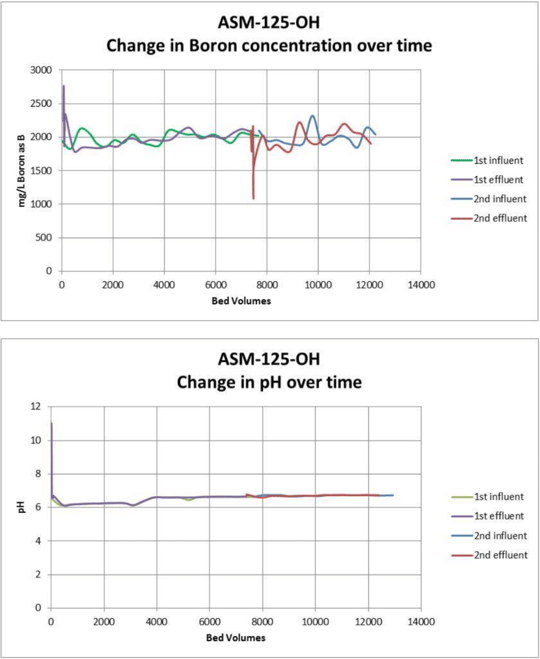
Before discussing the silica results it is perhaps worth considering the possible change in composition of the fuel pool itself. In general the effect was minimal. As might be expected, the hydroxide form resins removed boron for a short period of time, then equilibrated as the resin converted into the borate form. After that, there was no significant change over time.
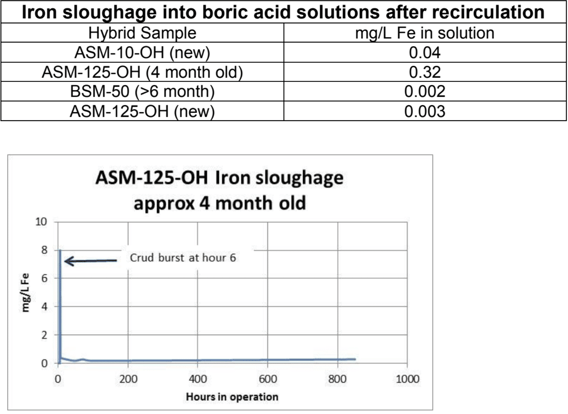
The sample of ASM-125-OH was approx. 4 months old and had started to show a crust of iron on its surface. As the resin converted into the borate form it shrank. The crust loosened and came off the surface of the resin, resulting in a brief (less than 5 minute duration) crud burst of particulate iron. This led to an increase in iron concentration in the entire solution and imparted a somewhat cloudy appearance. Iron was gradually filtered out by the resin, however, every time the flow rate stopped or changed suddenly, a brief but smaller crud burst occurred. Total iron in the solution increased to approx. 0.3mg/L due to the particulate sloughage.
The second column, with freshly regenerated hydroxide form hybrid resin did not exhibit this iron sloughage, nor did the later tests with older borate form hybrid or with reasonably fresh (less than 3 month old) hydroxide form hybrid.
The hybrid used in the second column was slightly different than ASM-125-OH and was prepared from ASM-10-HP. This product uses a type II strong base anion resin rather than the type I strong base anion resin used in ASM-125-OH. The silica removal by the Type II hybrid was not quite as good as from the Type I hybrid.
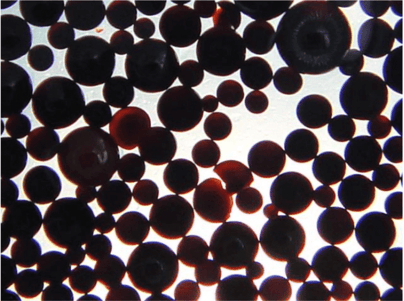
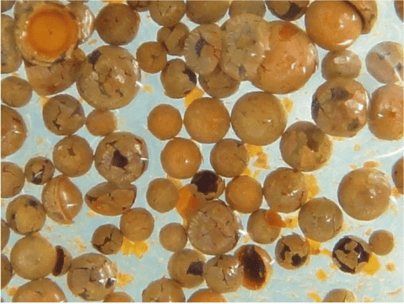
New hydroxide form hybrid
Form month old hydroxide form hybrid
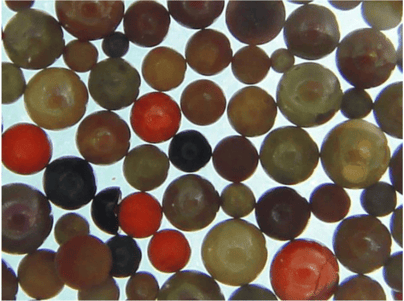
Two year old hydroxide form hybrid
Except for the crud burst from the aged ASM-125-OH, there was very little change over time in the solution composition, except for a very brief time while the hydroxide form resin was converting into the borate form. The following charts show the change in boron and pH over time.
Silica Reduction
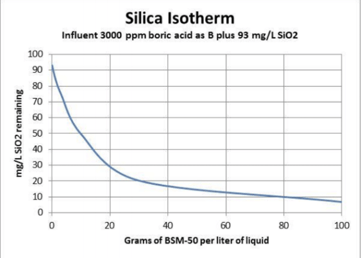
Silica removal was quite rapid for the first 300 to 400 bed volumes, then slowed. The effluent from the resin column was directed back into the same tank used to feed the column. This resulted in a steady decrease in the silica concentration in the feed.
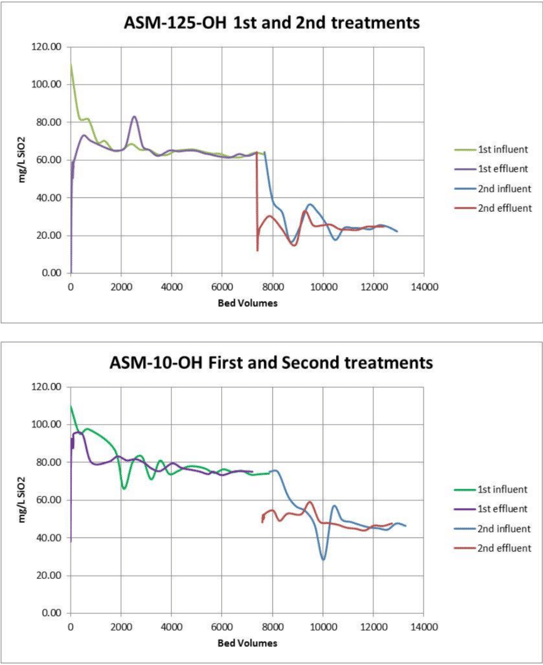
The first treatment reduced the silica from 110 ppm to approx. 60 ppm, the second from 60 ppm to 20 ppm. Although silica removal was not complete, the two treatments resulted in more than 80% reduction of the silica in the borated water, without changing the overall chemistry of the solution.
ASM-125-OH (made with a type I anion resin parent) demonstrated better silica removal than ASM-10-OH (made with a type II anion resin parent). ASM-125-OH also exhibited lower TOC leaching.
The spent resin was digested and analyzed for trace metals.
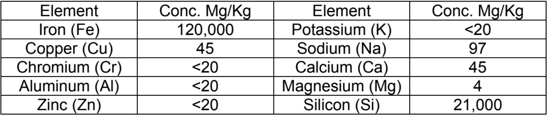
The iron represents the hybrid adsorbent inside the resin polymer. Silica is absorbed during the treatment process. Other metals might be from the ferric chloride and salt used in the manufacturing process. However, the very high iron content in the matrix makes the analysis of other trace metals quite difficult.
Second test
The second test was done with somewhat higher boron content (3000 ppm as B) and lower silica (16 ppm as SiO2). Solution volumes and flow rates were the same as in the first test, however the resin volume was reduced to150 mLs.Three resins were trialed, ASM-125-OH, ASM-10-OH, and BSM-50. BSM-50 is similar to ASM-125 but is provided in the borate form rather than the hydroxide form. The two hydroxide form resins were freshly made and none of the columns leached iron at measurable levels.
The test was scaled to mimic a RW tank

Silica Results
Silica removal by the hydroxide form and borate form hybrids made with type I anion resin were similar. BSM-50 produced the lowest residual silica in solution but also started with somewhat lower silica in solution. Silica removal by hydroxide form ASM-10-OH (with a type II anion parent) was not as good. It took three (smaller) treatments to approach the goal of 2mg/L of silica remaining in solution.
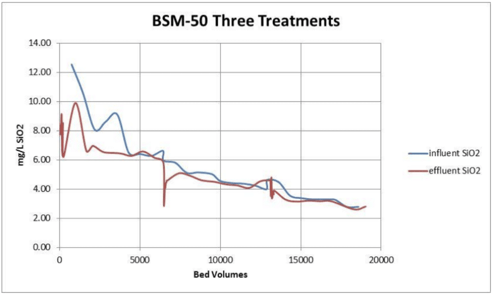
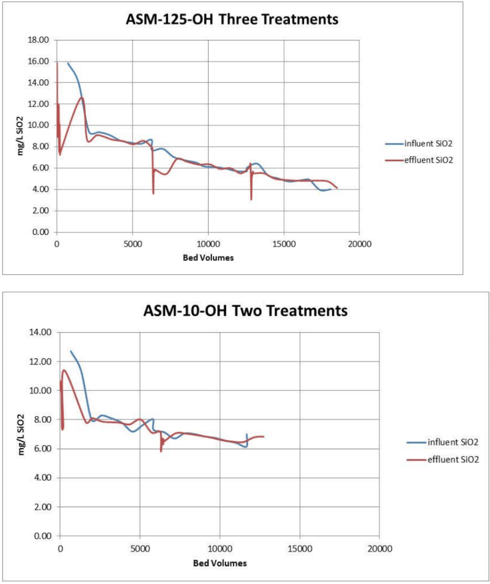
In all three tests there was no measurable iron sloughage. Iron levels in the borated recirculating water remained at less than 10 ppb throughout the test.
Boron levels and pH quickly stabilized. The hydroxide form resins caused a significant spike in pH initially compared to the borated form BSM-50.